Hmmm. In case there's been any doubt, I'm still on a sabbatical.
Not sure why I felt this sudden need to make this declaration, but here it is.
It was a slow day today. I finished the remaining pages of Animorphs Series: The Invasion, and watched some more Linus Tech Tips, and that's basically it. I aim to at least complete the Quadtrees and Octrees chapter/article in Handbook of Data Structures before I turn in for the night.
I did spend some time tweaking a bit more on the presentation on my personal domain, adjusting the way paragraphs show (paragraphs following other paragraphs are indented), and added more subtle line-based separations per year in my read-list page.
I saw this article today and reflected a little upon my experiences with taxis in Singapore. There was a time where they were quite reliable, in the sense that it was possible to hail one as and when one needed one, to get to the place that one wanted to go.
They are still rather useful to getting to and fro the airport from home (to requires an advance booking which can be easily done over the phone, while from is settled through the dedicated taxi stands at the airport itself), but other than that, their reliability has gone down to the point that I would not willingly take one unless I really have to.
And I still refuse to take so-called ``private-hire cars'' if I am on my own, but that's a rant for a little later.
I want to support the taxi drivers, I really do. But they are making it hard for me to support them. For some reason, they have started to demonstrate extreme pickiness from street hails. Previously, I would expect no more than 2 failures after flagging before I could get on a taxi to where I wanted to. Now, I would be damn lucky if I can get less than 5 failures from flagging. To be precise, when I say ``failures after flagging'', I mean that the taxi must first stop after my flagging of one, and then refusing to take me to my destination after ``demanding'' to know where I was heading before I boarded.
If I wanted to include the number of failed flags, then the numbers are much worse: previously, it would take on average of 5 cabs passing by before one would stop. Now, the number is closer to 15, with at least 2 that would suddenly switch from the green ``TAXI'' to the red ``BUSY'' when they saw that I was flagging for one on the roadside.
To be fair, I do have slightly better luck at designated taxi stands, but even in those cases the pickiness is definitely on the up-tick.
Taxis as a mode of public transport was traditionally the fall-back for when one screwed up the timing and cannot hope to reach one's destination in time with the mass public transport modes of the buses and/or MRT (subway). It was reliable for that then, but now, it is not reliable enough for that.
In fact, the time taken from starting to hail a cab to actually arriving at the destination nowadays is almost the same as if I just took the mass public transport modes and suffered the delay from my own doing, while simultaneously over-paying by at least 10×. So, I get to be late, and pay much more, with even greater stress.
All in all, a lose-lose-lose situation.
Because of that, I have not really put taxis in my list of viable transport options for quite a while already. I would rather take the extra time for the regular mass public transport modes, or walk than to rely on the taxi. It's a good thing because it forces me to be much more disciplined in planning my travel. It reminds me of the times that I was studying/living in the US, where there was basically no such thing as a taxi anyway, mostly because they cost at least 35× that of the bus, and are very hard to flag too.
And now, on ``private-hire cars''. Man... I don't know where to start on my dislike of these services. Maybe I'll start with the most selfish reason: I really don't like it when my money gets trapped in an app on my cellphone. Heck, I am still very angry with DBS for forcing everyone to use the digital token on the cellphone. I can go on an angry spiel on the privacy angle, but I will do a much simpler one.
It fucking gives Google/Apple too much damn power, because it is completely reliant on these third party infrastructure providers. If for any reason one gets banned from these platforms, either because of an automated false positive flag or through real mischief, things get locked out hard. At least for banks, it is still somewhat possible to talk to a human at one of their branches armed with nothing more than oneself, one's NRIC, and one's bank card.
But third-party ``private-hire car'' platforms like Grab and all? Money that goes in stays in there for as long as they can make one do so, and even if there are ways to extract one's fiat money out of that system, it is likely to require many hoops to be jumped to make it technically possible but practically improbable.
The other reason why I don't like ``private-hire car'' platforms is their inherently exploitative nature. I'm pretty sure that I had mentioned it at some point that such platforms that support the so-called ``gig-based economy'' is just the capitalist way of side-stepping all the labour protections that had been navigated through blood and sweat over the past century and change. In the original incarnation of actually acting as a ``side-hustle'', it is still tolerable with a strong sense of personal choice---one is expected to only take up gigs during one's ``free'' time to generate some income from some ``free'' resources that one might have (like time, and a vehicle that would otherwise be depreciating normally with no supplementary income to defray its depreciation).
But these platforms have reached the point where they are fast becoming an alternative source of actual ``full-time'' income for many people, and the regulations for these are still vague and unenforced, which allows the fairness of the underlying match-making inherent in the successes of these platforms' operation to remain opaque, and thus susceptible for abuse/exploitative practices that cannot be proven/disproven.
Since the money in these platforms are still great, there is little incentive to actually reign in on errant players who are actually exploitative. I cannot even say with certain if any platform is not exploitative, since what ``exploitative'' means is never really well-defined in the legal sense.
Despite all the corruption that we see in many governments, I still believe that one of the roles of the government is to protect its human citizens to ensure that the intangible concept of human dignity is respected. For many of us, this means the proper regulation and enforcement of said regulations for any activity that involves humans, especially when economic success [of the corporations] are concerned. Corporations retain lawyers to defend their rights, but the man-on-the-street has no one other than regulation on their side to protect them from abuse.
If only people were to repent from their sin of covetousness... then perhaps I don't even need to have such a rant in the first place.
Ah well. I think that's about it for now. Till the next update then.
Saturday, April 24, 2021


Welcome to Stupid O'Clock Again
Ooh, look at the time: it is stupid o'clock.
And strange rants usually occur at stupid o'clock.
A Redditor (u/strydar1) wrote this (replicated here for reference):
Perhaps that is why it is said that it takes at least as long as a relationship had been going on in order to recover from that particular break-up. I am definitely in much better shape than I was nearly a year ago today. When she told me that she was going to break up with me, it hit me so hard that there was nothing that I could do but cry. I cried, God knows how hard I cried. That kind of ripped-out-my-heart feeling... can probably only be matched by the death of a close loved one. It was that gut-wrenching.
Life was less meaningful from that day on. We were in the middle of a pandemic-induced ``circuit breaker'' scenario, which basically meant that everyone was isolated from everyone else. Work was a jerk, night and day had no difference, and I had to keep it together still because I had an intern to guide through. I made my acquaintance with the Lord and started walking in His footsteps as well as I could. I did contemplate death ever so often, mostly unintentionally and intrusively, but sometimes there was some actual deliberation involved.
I talked to some of my friends, but I realised that at some level, our interests and synchronicity have diverged. And I really didn't have the right words to convey what I was really feeling, because I didn't know what I was feeling any more.
No rehearsals meant no way of just getting back those much cherished routines of life that give the man drowning in his own depressive thoughts an anchor point of normalcy to start again from.
Today, nearly a year on (I could, in theory, look it up to confirm the date, but I don't think it productive to do so), I find that I'm still numb in that region of my heart. I am still an equal-opportunity ``hater'' of people, which also means that I am an equal-opportunity ``lover'' of people, because being neutral is also, by definition, equal parts of both antagonising perspectives. But that part of me that normally would have the angst of having a mate, a companion, a comrade-at-arms, that part is still numb; can't feel anything other than an occasional sadness that I do not know how to articulate.
I don't know if it is still just me grieving, or if it is just a tacit understanding that this type of longing is no longer necessary nor needed ever since I turned my eyes upon Jesus:
But I digress far from the metaphor that was offered by u/strydar1. I think I mentioned something similar before, but instead of talking about waves, it was more on the auto-triggered memories, and the need to form new memories to re-contextualise the memories so that the newer ones without the significant other overrides the old one and thus reducing the level of grief and other bad feelings. However, new memories do take time to take proper root, and in the process of trying to create these new memories, the old ones are still lurking just beneath the sub-conscious, ready to spring out and spoil the whole day.
The trick, it seems, is to let the old memories come out into the open, but pay it no heed, letting it ebb and flow accordingly while actively recalling the new memories as much as possible. It is a concept that comes from the mindfulness form of meditation, and also from the various error-propagation protocols used for training neural networks.
Meaningless drivel at stupid o'clock... it's not as though what I have written here has any hope to have coherence in the first place.
Till the next update.
And strange rants usually occur at stupid o'clock.
A Redditor (u/strydar1) wrote this (replicated here for reference):
I didn't write this. But it's true.He's not wrong. The waves never stop coming, and we don't know what's going to trigger them.
As for grief, you'll find it comes in waves. When the ship is first wrecked, you’re drowning, with wreckage all around you. Everything floating around you reminds you of the beauty and the magnificence of the ship that was, and is no more. And all you can do is float. You find some piece of the wreckage and you hang on for a while. Maybe it's some physical thing. Maybe it's a happy memory or a photograph. Maybe it's a person who is also floating. For a while, all you can do is float. Stay alive.
In the beginning, the waves are 100 feet tall and crash over you without mercy. They come 10 seconds apart and don't even give you time to catch your breath. All you can do is hang on and float. After a while, maybe weeks, maybe months, you'll find the waves are still 100 feet tall, but they come further apart. When they come, they still crash all over you and wipe you out. But in between, you can breathe, you can function. You never know what's going to trigger the grief. It might be a song, a picture, a street intersection, the smell of a cup of coffee. It can be just about anything... and the wave comes crashing. But in between waves, there is life.
Somewhere down the line, and it's different for everybody, you find that the waves are only 80 feet tall. Or 50 feet tall. And while they still come, they come further apart. You can see them coming. An anniversary, a birthday, or Christmas, or landing at O'Hare. You can see it coming, for the most part, and prepare yourself. And when it washes over you, you know that somehow you will, again, come out the other side. Soaking wet, sputtering, still hanging on to some tiny piece of the wreckage, but you'll come out.
Take it from an old guy. The waves never stop coming, and somehow you don't really want them to. But you learn that you'll survive them. And other waves will come. And you'll survive them too. If you're lucky, you'll have lots of scars from lots of loves. And lots of shipwrecks.
Perhaps that is why it is said that it takes at least as long as a relationship had been going on in order to recover from that particular break-up. I am definitely in much better shape than I was nearly a year ago today. When she told me that she was going to break up with me, it hit me so hard that there was nothing that I could do but cry. I cried, God knows how hard I cried. That kind of ripped-out-my-heart feeling... can probably only be matched by the death of a close loved one. It was that gut-wrenching.
Life was less meaningful from that day on. We were in the middle of a pandemic-induced ``circuit breaker'' scenario, which basically meant that everyone was isolated from everyone else. Work was a jerk, night and day had no difference, and I had to keep it together still because I had an intern to guide through. I made my acquaintance with the Lord and started walking in His footsteps as well as I could. I did contemplate death ever so often, mostly unintentionally and intrusively, but sometimes there was some actual deliberation involved.
I talked to some of my friends, but I realised that at some level, our interests and synchronicity have diverged. And I really didn't have the right words to convey what I was really feeling, because I didn't know what I was feeling any more.
No rehearsals meant no way of just getting back those much cherished routines of life that give the man drowning in his own depressive thoughts an anchor point of normalcy to start again from.
Today, nearly a year on (I could, in theory, look it up to confirm the date, but I don't think it productive to do so), I find that I'm still numb in that region of my heart. I am still an equal-opportunity ``hater'' of people, which also means that I am an equal-opportunity ``lover'' of people, because being neutral is also, by definition, equal parts of both antagonising perspectives. But that part of me that normally would have the angst of having a mate, a companion, a comrade-at-arms, that part is still numb; can't feel anything other than an occasional sadness that I do not know how to articulate.
I don't know if it is still just me grieving, or if it is just a tacit understanding that this type of longing is no longer necessary nor needed ever since I turned my eyes upon Jesus:
Turn your eyes upon Jesus,The things on earth do grow strangely dim for me---that is one big reason for the sabbatical; to find back that sparkle that would have led to a spark and then flame of enthusiasm and vigor. Somehow, somewhere along the line I lost them---I don't know how. Perhaps it was the exploitation, or perhaps it was not being true to myself, almost always just going with the flow, even if it feels bad. Or perhaps it is because I know that had I followed the original trajectory I was on, whatever I might have done will not actually bring honour to God, or to put in layman's terms, is not morally defensible.
Look full in His wonderful face,
And the things of earth will grow strangely dim,
In the light of His glory and grace.
But I digress far from the metaphor that was offered by u/strydar1. I think I mentioned something similar before, but instead of talking about waves, it was more on the auto-triggered memories, and the need to form new memories to re-contextualise the memories so that the newer ones without the significant other overrides the old one and thus reducing the level of grief and other bad feelings. However, new memories do take time to take proper root, and in the process of trying to create these new memories, the old ones are still lurking just beneath the sub-conscious, ready to spring out and spoil the whole day.
The trick, it seems, is to let the old memories come out into the open, but pay it no heed, letting it ebb and flow accordingly while actively recalling the new memories as much as possible. It is a concept that comes from the mindfulness form of meditation, and also from the various error-propagation protocols used for training neural networks.
Meaningless drivel at stupid o'clock... it's not as though what I have written here has any hope to have coherence in the first place.
Till the next update.
Friday, April 23, 2021
Scratching Various Itch
Ah... feels great to be sitting in front of Eileen-II to write yet another blog entry after a day of [sorta] gallivanting about. I really could get used to this.
I scratched a few itches today. The first of which was to sort out my Tex-Mex craving with stuff'd at 90 Hougang Ave 10, #01-38, Singapore 538766, near Hougang Mall. Yes, I said Tex-Mex, and I'm well aware that stuff'd is ``mexican, turkish, delicious''. But that applies only if one is ordering the kebab, which I did not. I just went for the Beef Con Carne Burrito with all of the Standard Base and Standard Toppings, with Habanera and Sweet Mustard Sauce. It is mmm mmm good, naturally. I am really happy that stuff'd exists in Singapore now---back in the day circa 2011, I was craving burritos really bad after having come back from the US and learning about Chipotle Mexican Grill, which served delicious burritos as large as my head. There was no easy-to-find burrito place that tasted great---everywhere was some kind of bowdlerised restaurant that charged an exorbitant fee (think SGD 25+) per [tiny-ass] burrito(!). It's kinda like heading out to somewhere not Singapore, and having to pay like SGD 30 equivalent for friggin' Hainanese Chicken Rice in Filet Mignon-sized portions. stuff'd came into existence only in 2014, and it has been a true godsend to me throughout the years that I spent in Singapore after returning from my second round of overseas studies.
Like all things that I love, eating the burrito from stuff'd is bittersweet. I think it was recommended to me by Chara back in the day, and we had many a date spent just sitting at some random place and chowing down on them burritos. It was always burritos, whether it was the chicken or the beef con carne. Well, all these memories are in the past now, and I need to create new memories to move on, and so I shall.
The other itch that I scratched was to go play with my friend's cat. His cat is new, having only been recently adopted from Kittycare Heaven, located at 80 Lim Chu Kang Lane 1, Singapore 718911. He is a real beauty, being a ragdoll cross, and is really friendly too. It took a while, but I was soon scritching his nape, back, and even his belly. He mewed, and purred quite a lot as well. He was still young though, estimated to be around 9 months old or so. According to my friend, he eats a stupid amount of meat, nearly 8× the quantity that his previous cat ate per day, at a rate that would rival any of the conscript soldiers in the SAF.
He is a sweet thing, and I am glad that my friend and his wife adopted him. God only knows they really need a joy-maker in their life, ever since their old cat passed away some time ago from kidney failure.
The final itch that I scratched today was more tweaking of the header colouring and margins. Last time I talked about using colour to ``pop'' the section header out---this time I added more highlights for the sub-section headers and lower to make it easier to pick them out in a wall of text. One version of them can be seen at this dizi article [with missing diagrams], which also shows the adjustments I did to the figure caption as well.
I am satisfied with the results---they provide that additional visual cue on the document structure that the older method of messing with underlines and small-caps alone could not do as effectively. The highlights started at gradient from 50% of width at h3 level, before dividing by 2.5 each time we increase the header depth, till we get to 3.2% of width at h6 level. Why the 2.5 factor? I'm not too sure; I only remembered that a factor of 2 looked lame, while a factor of 3 seemed to decay too much. On hindsight, perhaps I should have messed with using φ or even e as factors, but it's too late---I'm too lazy to do even more adjustments now.
Originally, these highlights used the same starting colour as for the h2 level, but I decided to lighten it up a bit more to make it stand out. I added an additional white border around the text for h3 to h6 levels just so that if for any reason the text gets too long and reaches the blue-ish area, the text will still be readable.
I would add that apart from all these, I watched a bit more Daria Restoration Project while lazily attempted more runs on Jupiter Hell.
All in all, it has been a nice day. Till the next update then.
Thursday, April 22, 2021
AoC on Hard in Jupiter Hell
Well, I mentioned before my attempts in completing Angel of Carnage at Hard difficulty level in Jupiter Hell.
After many retries, I finally made it. The long story short is the need to be careful in when I choose to move, which is hilarious since it is the type of activity that is common in such rogue-likes in the first place.
I think I'll retire to passive entertainment (watching The Daria Restoration Project) for the rest of the evening. Or maybe, just try something different in Jupiter Hell while simultaneously listening to The Daria Restoration Project.
That's all for now. Till the next update.
Popping Out Section Headers
Well, I spent most of the day thus far trying to get through Angel of Carnage on Hard mode in Jupiter Hell while simultaneously watching the Daria Restoration version of Daria. The Restoration version basically takes the latest DVD collection's remastered visuals, and combines it with the original sound of the VHS versions that came about from individual's recording before the remastered version came out.
The DVD collection came out only many years later, and had its sound re-done with genericised music tracks since it was prohibitively expensive for licensing---the original TV run of Daria was on MTV during an era where they could get lots of good/relevant pop music to go with it.
I've watched the VHS version many times, the updated DVD collection even more times, and now, I'm getting the best of both worlds.
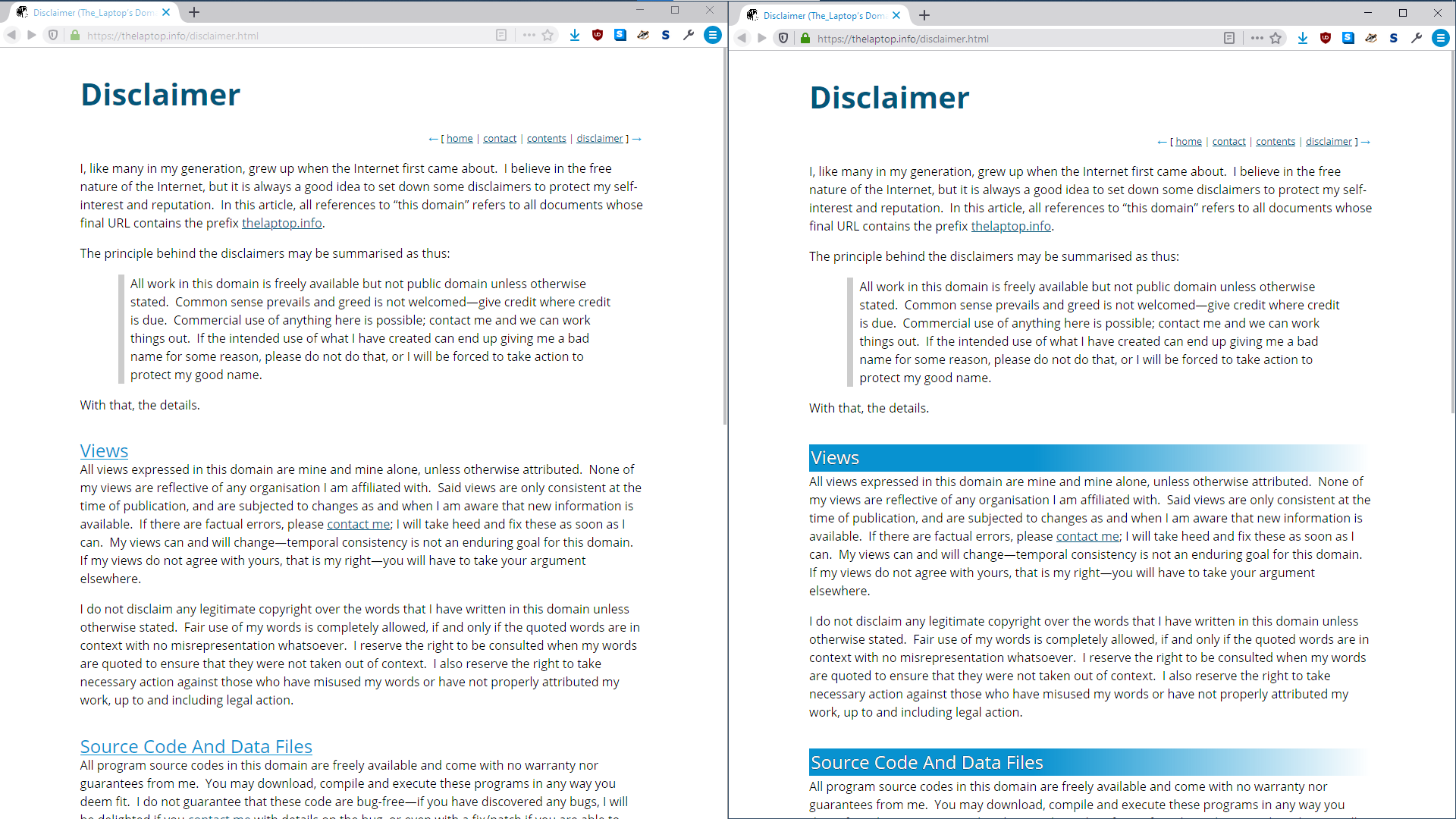
While poking around and learning that Wendy Hoopes, voice actress for ``Jane Lane'' is born in Malaysia back in 1972, I also learnt about the gradient box in CSS for the header. I liked the set up, and tried it out on my web domain to make the intra-page sections stand out. I think it does stand out well. The only other adjustment I did was to add a thing text shadow around the white text to ensure that if the header information get long enough to run into the white part of gradient, it will still stand out.
I think that's all I want to write for now. Till the next update.
Edit: It seems that there is a new spin-off/reboot of Daria called Jodie that was ordered in June 2020 with no release date yet. Should be interesting!
The DVD collection came out only many years later, and had its sound re-done with genericised music tracks since it was prohibitively expensive for licensing---the original TV run of Daria was on MTV during an era where they could get lots of good/relevant pop music to go with it.
I've watched the VHS version many times, the updated DVD collection even more times, and now, I'm getting the best of both worlds.
While poking around and learning that Wendy Hoopes, voice actress for ``Jane Lane'' is born in Malaysia back in 1972, I also learnt about the gradient box in CSS for the header. I liked the set up, and tried it out on my web domain to make the intra-page sections stand out.
I think that's all I want to write for now. Till the next update.
Edit: It seems that there is a new spin-off/reboot of Daria called Jodie that was ordered in June 2020 with no release date yet. Should be interesting!
Wednesday, April 21, 2021
7 Pints of Guinness and Other Diversions
Okay, so I mentioned before that I was heading to my favourite bar, which I did. Got some good reading done [naturally]---page 379/1321 of Handbook of Data Structures and Applications, completion of Animorphs Series: The Andalite Chronicles by Katherine Alice Applegate, and page 42/77 of Animorphs Series: The Invasion by the same.
Apparently I had drunk 7 pints of Guinness stout, or roughly a pint an hour for the whole 7 hours that I was there (from 1415hrs to about 2115hrs). I mean, I had some finger food and ``regular'' food to go with it for lunch/dinner, but apparently the 7 pints were enough to make the store manager a little bit concerned about my safety getting home.
I reassured her that it was fine. Frankly, I didn't even feel anything more than buzzed. She did mention that she didn't realise just how much I could drink, but I didn't dare to lionise what I have done by pointing out that before heading to my favourite bar, I had already downed two cans of Tiger beer at home.
It's good to feel a little buzzed every now and then. Takes the edge of reality in some ways.
On the way home, I was listening to an album from SDN48. The pieces they have were sung in Japanese, but had a really high-energy beat to it, which was just the right amount of energy that I wanted.
Which of course segues into a completely different topic. When I play the high pitched instruments (like the 梆笛 or the soprano saxophone), I mentally switch myself towards ``diva''; in other words, whenever I go high, I re-imagine myself as an accomplished female soprano singer, the first lady in the orchestra. It helps with setting the right attitude and all the subtle adjustments necessary to ensure that my entire breathing tract is in tune with the rigours of playing high notes.
And no, I don't have some kind of gender dysmorphia, in case there was any doubt. I'm still a cis-male, but I find that putting myself into the shoes of a prima donna is a great way to sound much more controlled and light when playing high. It's just another way of acting, though less intense than say method acting where one is a role as opposed to one takes on a role.
Since my natural voice and volition is no where near sounding like a prima donna, I suppose it is why I have a tendency to favour listening to music that is sung by female singers, with bonuse points if they go high but do not sound squeaky.
These days though, I'm starting to expand more on the lower end of the range. I mean, yes, having the right mental model to play high is essential for 笛子 playing, but with the alto flute, bass flute, and tenor saxophone, I really need to beef up my lows. As time goes by, it will be increasingly easy to go lower on my natural voice than to keep going higher---going high by voice is always doable through careful constriction of various parts of the breathing tract, but the lowest note that one can sing (and therefore shape properly on a woodwind instrument) is completely limited by the length of the breating tract and its diameter.
There's a reason why the lowest oktavists are generally tall and/or old men. No woman is ever going to reach the deepest of the bassi profundi no matter how much they try---it is literally impossible for them due to physiological limitations. To be fair, for male voices to go to the highest soprano range without resorting to falsetto isn't exactly the easiest of things either, but as I said before, ``squeezing'' out a high pitched note is always feasible, even if its timbre sounds like garbage.
On a completely unrelated note, I just want to point out that O(log (n!))~O(n log n) from Stirling's approximation.
I think that's really about all for today. Till the next update then.
SMS Musing #11
While hanging out at my favourite bar and looking over at a neighbouring table and seeing a cute female:
At some fundamental level, I need to ask myself: do I just have really bad taste in women. Or more fundamentally, am I sufficiently untrained in the arts of choosing a mate for life, no thanks to the policies of school (I'm staring at you, RVHS with your "no BGR" nonsense), my bad skin in general, my spending of my so-called prime dating years studying overseas under the spectre of over-achievement (I'm staring at you, A*STAR for that 3.8 GPA requirement). The women that attracts me the most (and are attracted to me.in return) are abnormal in their own ways---either they really aren't into starting some kind of family, or are otherwise "pre-occupied" with other aspects of life.
I'm not going to lie; I'm not even sure it was actually worth it ti be on that scholarship that I was to study abroad and then return with a useless Masters degree. What's the point of studying so much and so hard if in the end, all I'm looking at is being exploited by people for not even the value of all the training that I've been through, without any sort of happiness.
It would seem that all that study and training has brought me nothing but angst, doubt, and bitterness, with a severely under-developed sense of the humanising self. I mean, I started with low attraction to women, but as the years go by, I am getting ever less attracted to them. It's not that I've "gone to bat for the opposite team", but that the foibles and failings of mortal humans in general, and the repeated demonstration of misplaced trust in people has made me super wary of wanting to start yet another [serious] relationship.
I pray weakly to God to guide me in terms of this. But frankly, as this sabbatical goes on, I am increasingly convinced that there is probably no other human female that is worthy enough of my trust, loyalty, faith, and love.
Sure, I might miss out on the sex, but is it really a loss? Maybe I might miss out on the companionship, but isn't a God-centric life supposed to ameliorate that?
First World Problems
``Minority'' is not a universal statement but a conditional one.
Now, before the mob grabs pitchforks, let me be a bit more precise---I mean this in a probabilistic sort of way. The concept of what a ``majority'' or ``minority'' is depends on the population in which we are determining the subset of. So for instance, say one is in America. Then people of Chinese ethnicity (very loosely defined as being people descended from China up to five generations ago) are in the minority as compared to the population that makes up the geo-polity that is ``America'', even though people of Chinese ethnicity in China is close to 100% [by my definition above].
In short, the concept of majority and minority depends very heavily on the definitions that are used. This is no small matter, and can affect the way in which the conversations of privilege and disenfranchisement are conducted. To a large extent, public policy is guided by how these definitions are determined, and I think that part of the engagement between the national governing bodies and their citizens should include alignment of these definitions so as to ensure that all citizens [that the governing body serves] are treated fairly.
That brings us to another tricky point: what is the definition of ``fairness''? There are two big concepts that have gained a consensus in their meanings, that of equality (everyone is given the same resources/opportunities) and of equity (an acknowledgement that everyone comes from different circumstances and therefore needs to have different resources/opportunities allocated to get the same outcome).
Crudely, meritocracy can be considered a philosophy of equality, while affirmative action can be considered a philosophy of equity.
Both are ``fair'' depending on what one prioritises same-ness for. My current working hypothesis is that there is no single eternal mortal governance system that is without flaws (because people are always actively gaming the system for their own personal benefits instead of playing ``nice''), and because of that, equality or equity as the measure of fairness is something that needs to be re-examined ever so often, with neither philosophy absolutely dominating the other.
Going back to the matter, the concept of establishing ``fairness'' for minority peoples in a society. At some level, I think that the over-arching consensus despite either philosophies of fairness is that people are treated without specific preference or negative bias, that the behavioural choice of those who are acting under the aegis of officialdom be one that is physical evidence driven and defensible as being unbiased. This means that those who act in official capacity will stay within the rules of engagement, and within the rules of decency, despite who they are interacting with. This is a much lower bar than requiring that everyone in a society treat each other in a civil fashion based on observed actions instead of inner prejudices.
That is why there is a lot of anger against police officers in the United States that seem to behave according to their inner prejudice instead of basing it on the more defensible rules of engagement of law enforcement. But to be fair, such misbehaviour isn't limited to just some police officers in the US; it's just that the US being relatively transparent in their media about what is going on in their country means that any blemish can easily get scrutinised and magnified at a global scale. I can safely say that there are other countries and territories that have similar or worse problems, but considering that the current media juggernauts are still Western technology companies, it will be hard to notice/see them.
But human governance is hard. I'm glad that justice eventually turns up [in the mortal world]. That said though, even if such human justice never turns up in our life-times, at some level one can hope that God will enact His morality on those who sin. But what He does specifically, and when He does it to whom isn't for us to know---faith requests that we seek comfort in knowing that a moment's folly with no repentance is stacked against the eternity and awesomeness that is God's wrath, and that His Will be done.
That alone allows me to sleep at night knowing that even though I'm but a mote, it will all be well in the end. And as long as it isn't well, well, it isn't the end.
------
In other news, I think I'll head out of the apartment today to do something different. Gonna be bringing Eileen-II out as well, though not sure if I will just stick with reading or if I will do some kind of programming as well. I'm also uncertain what kind of day it is, but part of me wants to go to my favourite bar to hangout partly because it is much closer, and partly because unlike my favourite sushi place, it is open at odd hours, meaning that there are way fewer people to worry about.
Then there's that craving for Tex-Mex food that I feel like I need to deal with.
So many first world problems huh.
Alright, enough of ranting for now. Till the next update.
P.S.: I think I'll head to my favourite bar for reading, beer, and luncheon meat fries.
Tuesday, April 20, 2021
AoSh and mala Hotpot
Today's a mix of some Jupiter Hell achievement seeking and reading.
I've progressed to page 289/1321 of Handbook of Data Structures and Applications, as well as page 936/2863 of the SCP Tome 5---SCP-2000 to SCP-2499. Nothing much to talk about there.
I have also completed the Angel of Shotgunnery challenge for Jupiter Hell. It was a fun one, and the details of the post-mortem can be found where I linked to.
I had an early dinner at 辣'不辣麻辣香锅 at 683 Hougang Avenue 8, #01-923, Singapore 530683. I've known about their existence at that spot for quite a while, and it was only recently that I actually went there to try their food.
Man, it reaally scratches that mala hotpot craving. That piquant flavour combined with the numbing spicy peppercorns is just amazing. Naturally, it's probably not the best mala hotpot in town, but as I have said many times before, sometimes the best food stall is just the one that one can have easy access to for the freshly made food. It's the same principle as I apply for prata, going for Al Falah Restaurant over at 681 Hougang Ave 8, #01-855, Singapore 530681 if I truly wanted prata [alone].
Or even Sin Heng Kee porridge over at 685 Hougang Street 61, #01-150, Singapore 530685, though to be fair Sin Heng Kee is considered to be among the best places for porridge in Singapore.
But my point is, tastes can change and adapt through frequent access, and thus having easy access to a certain food is definitely the best way to develop a certain taste for it. After all, food is very cultural in nature, and so what counts as ``good'' or ``not good'' is really in the eyes of the beholder. Any and all reviews for food should thus be considered individually to take into account the level of similarity between one's tastes and the reviewer's.
I mean, unless the day comes where reviewers start quantifying the flavour, texture, and other other physical properties of food via stating the concentrations of the various ions that create the flavour profile, and associated SEM, I would stick with this additional informal application of the K-L divergence interpretation.
I'm about to go for a bible study session with my care group, and so, I will just end this entry here.
Till the next update.
Monday, April 19, 2021
Lost in Data Structures and Other Reading
Today is a reading sort of day.
Apart from Bible in One Year 2020 With Nicky Gumbel (day 346/365), I've also made some progress on Handbook of Data Structures and Applications (page 220/1321), and Harrison's Prinicples of Internal Medicine (20th Edition) (page 357/3790).
There were also a bunch of other shorter works that I read as well.
After that, a little bit of time was spent in Cyberpunk 2077.
A friend of mine started a new venture, providing consultancy services for human resources and other business-improvements. It made me think a little of a possible direction in which I can head down; that is to do consultancy for __________ . It's currently left as __________ only because I have not thought about what __________ can be. Maybe infocomm technology related, maybe general problem solving; or maybe even music.
Who knows?
There really isn't much to talk about for today---it's been rather quiet. So I think I will just end the entry here.
Till the next update then.
Sunday, April 18, 2021
Sheet Metal Rules the World
It's been a quiet day. I think that this is likely to be the type of beginning for my entries for a long while to come as people start to forget about my existence as the year (and my sabbatical) goes on. But it's okay.
I spent much of the day reading The Book of Malachi, the remaining 10 psalms from Psalms, and The Revelation of Jesus Christ from the New King James Version. With that, I have successfully finished reading The Holy Bible, New King James Version. This second read-through definitely has a different feel to it, partly because the text is better formatted (with a more modern English), and partly because I am reading it from the perspective of a believer as opposed to one who is merely curious about one of the biggest sources of inspiration of Western literature. I think I might have said it before, but the Old Testament really doesn't get much love---many people, well-meaning or otherwise, have a tendency to quote very heavily from the five books of Moses, but then conveniently forget about the later parts of the Old Testament that revolve around how Israel has sinned repeatedly, together with the associated ramifications and God's actions in getting them to steer back onto the righteous path.
Of course, this is where I say that I'm no theologist and not-so-subtly sidestep talking about the details of it. Please consult your neighbourhood pastor/minister/deacon for details about proper biblical interpretation.
------
I'm not sure if I ever talked about the I C Weld YouTube channel here. It's a fun channel of a guy who does heavy machinery repairs with his plasma cutter and various welding tools. It's not as heavily produced as say Linus Tech Tips, but there is a certain honest charm about it. It also helps that he is rather skilled at problem solving as well, including the art of articulating what it is he is doing, and why he is doing it. He does make it clear that he is merely showing how he does it, as opposed to how it ought to be done, which helps to set the correct tone that it is a showcase rather than a credited source of introduction.
Watching I C Weld and even Stuff Made Here made me realise that much of the industrial world's structures revolve around sheet metal. Anything structural has a tendency to begin life as some form of sheet metal, which includes things like pipes. This includes things like the many different types of cranes that feature as part of the repair videos on I C Weld itself. I think part of the reason why sheet metal is so important is just the ease of fabrication---metal is malleable, and many structures can be built out of simply bending a pre-cut sheet metal into the right shape. The resultant structure is as light as it can get without using exotic processes and using/wasting too much material.
This thought also made me realise that one of the earliest topics in primary school mathematics that appears in only one module, that of nets, actually plays a rather important role in modern industry. I mean, we can go even deeper down the rabbit hole and look at the mathematics of paper folding, of which there is a textbook on it, with practical uses of reducing space needed for solar panels and antennae without massive re-engineering of the stiff planar components.
I think I'm rambling again. Heh.
That's all I have for today. Till the next update, I suppose.
Saturday, April 17, 2021
Week in Brief
It's late on a Saturday night. The rain has already fallen, and it's a real cool one.
What better time than now to do a recap-type blog entry?
This week has been a strange one. I did not do much reading; at some level, I feel like that I have been ``read out'' for a while. More importantly, there was a different type of project to occupy me, and that is the building of a new PC for my mum. It felt like the right thing to do this time period, partly because of the exceeded tolerance level of re-seating the RAM chips every month or so due to corroding contacts, gradual loss of USB ports due to (you guessed it) more corroded contacts, the complete end-of-life of the Xubuntu operating system LTS release, generally super ancient hardware specifications, and partly because I wanted a different kind of thing to work on. All the oldness of the still sort-of working PC and generally reduced external connecting capability meant that we are starting on the other end of the bathtub curve.
It's been about 8+ years---the PC has had a good run. No regrets.
Throughout the process of figuring out what parts to get, to getting the parts themselves, to unwrapping and assembling, to operating system installation/set up, and finally to data migration and user integration, I found that time passed really fast. I mean, I knew the passage of night and day, but the sense of how the hours were passing was less clear, especially since I don't really eat lunch any more (I've been cheating with breakfast, and as such, my mass is increasing again; urgh).
I think I was genuinely having fun throughout the build process. That is a good thing I suppose, since it means that at some level, I still enjoy technical stuff.
I don't feel too bad for not doing ``enough'' reading for this week, nor did I feel too bad about not trying to ``complete'' Cyberpunk 2077---it just didn't seem to be that kind of week to me. I still got some good things done, and that is, for a lack of a better term, still good.
I wonder what the next week is going to bring to me.
Incidentally, this is the last day of the third month of my sabbatical. I am definitely more relaxed in comparison to the start, but I'm not sure if I'm truly well-relaxed yet. Thing is, there has been hints of rumours of the recent past catching up with me for some reason---I don't know what is transpiring, and am determined to not get involved in it. It isn't a true sabbatical if I cannot let go and move on, and it is important that I dictate my own terms in consultation with God, and not rely on someone else to dictate my headspace and time.
``This too, shall pass''---this sabbatical of mine isn't going to last forever; it's a sabbatical, not a retirement. The time limit for the sabbatical is one year, after which I will be embarking on the next leg of my journey, God willing, in a role that best glorifies God which makes use of all the talents that He has graced me with and the opportunities that He has provided me with to hone, display, and use them. Since my sabbatical has a definite time limit on it (nine months left from today), I am determined to not let the fleeting time in it be taken up by people who no longer matter as much to me as before.
Speaking of people who no longer matter as much to me as before, I learnt indirectly from a friend that Chara is no longer working at MusicGear. Well, it is to be expected, considering everything that happened; I wish her all the best on her pilgrimage to re-acquaint herself with God once more. My only otherwish is that she will still be in Singapore long enough that I can fulfil my last fulfillable promise to her---that I would invite her to my baptism ceremony when it comes.
When will it come? I'm thinking maybe within the upcoming year, but it will be by God's will, not mine.
------
In other news, I just ran the hair clippers around my head with the number 2 guide comb to neaten the mess. Recall that the last time I went for a hair cut, it was a full head shave. Since I got the trimmer, it was possible for me to keep and maintain side-burns as well, just to see how I look like. Now, side-burns work terribly if I went for a head shave, and so I just decided to crop my own hair this time round.
The same trimmers were also great at neatening the fringe hair, as well as the bits of hair that grow around the ear. The idea was just to run the 6 mm setting on the trimmer about carefully on the edges to neaten them. The number 2 guide comb is at 1/4", which is very roughly 6 mm (it's really 6.35 mm, but that amount is too subtle). In theory, I could just use the hair clippers to do it, but they are less nimble than the trimmer, making it that much harder to manipulate the cutting blades to do the right cut without actually knicking myself in the skin.
Anyway, it's starting to get late, and somehow, I am feeling tired. I think I will turn in for the night.
Till the next update then.
SMS Musing #10
While waiting for my food at the Harry's bar at Esplanade:
One thing that I miss during this period of COVID-19 restrictions is the lack of the use of my mouth as a "third hand". What I mean is the use of my mouth to hold on to small articles so as to free my hands to do other things. An example of this would be to hold my EZ-Link fare card in my mouth while I use my hands to hold on to the stair rails as I make my way down from the second storey of the double-decker bus. Another example would be to hold my note book while I am zipping my bag up.
Small things that one takes for granted until they are no longer available. I suppose that's just one of the many lessons that COVID-19 is teaching us.
Friday, April 16, 2021
The Mum PC = Success!
This is an early entry.
For those who have been following along, I finally built a new PC for my mum, and have installed the latest Xubuntu release that supports the new 11-th Generation ``Rocket Lake'' CPU. The stress test had successfully been concluded (my jealousy of the better thermals despite stock everything notwithstanding), and the PC was all but ready to be released back to my mum.
The only thing left to do was to migrate the old data that she had in the previous PC into the new one.
It is not as though my mum has a lot of source code or documents---instead, she has quite a bit of digital images/videos from the various cameras (phone and otherwise) over the years; it is best to think of it as a digital equivalent of a photo album. I definitely needed to ensure those files are available to her, as are her web page bookmarks in Firefox. She has already made her back-ups on the external HDD that I bought her recently, but I didn't want to use those since I could just use the original HDD directly connected into the new PC via SATA.
Anyway, I took apart the old PC and extracted the Hitachi 3.5" HDD (manufactured in 2009!) together with its SATA cable. It was then that I realise why it was impossible for me to do the type of cable management now then---the folded sheet metal that was used to construct the chassis simply had no space behind the motherboard for any form of cable management; it would seem that leaving about 50 mm of space between the mounting braces for the motherboard is a recent thing. That would explain a lot actually, and confirmed my observation that modern PC building was definitely much less painful than before. For instance, it is actually conceivable to build a nice water-cooled CPU set up with radiator now, whereas in the old days, anything that was not air-cooled via heat sinks and copious amounts of fan-mediated air flow was simply inconceivable---it was nearly impossible to route the liquid cooling lines through a constrained three-dimensional space with cables running every which way. This included the extra power cables from the non-modular power supplies. Incidentally, my mum's new PC does not have a modular power supply, mostly because the components that the mobo has onboard is just too few to justify potentially requiring more connectors.
The old HDD was connected into the new PC, and I booted it up, being careful to ensure that I did not accidentally boot off the operating system that was on the old disk. I didn't have to worry after all, since the old disk was using BIOS mode, while the new set up was all UEFI---there was just no way of booting off the old disk without doing some changes to the BIOS. Subsequent actions included mounting the /home directory into the new system's directory tree, and then copying out all the contents of the user-directory corresponding to my mum's previous system into the new one, before finally setting the correct ownership information.
After that was done, I spent a little bit of time setting up the rest of the environment for her, from importing her bookmark settings and reseting the desktop background image to be the same as the one she had before. When these were all done at my ``work bench'', I powered things down and took out the old HDD with SATA cable to be put away, closed up the chassis, and brought it back to the movable PC trolley to mount the new build.
I was so afraid that it wouldn't fit, but it turns out that my fears are unfounded. The width of the new PC was the same as the old one, but the height was only about 25 mm or so taller than the old one, which meant that it fit well. I plugged all the old peripherals back into place, including the monitor's VGA cable that went first into the HDMI-VGA adaptor before plugging the adaptor into the HDMI slot.
The biggest thing that I was worried about was the usability of the wireless mouse, since it was using an external dongle. After plugging everything in and powering on, I was first horrified that the screen was showing a really stretched out 1024×768 display, and then delighted that the wireless mouse worked out-of-the-box. I cussed out under my breath and just logged in first. I wanted to look at the display settings to verify some things before I completely cussed out everyone and everything.
Thankfully, it was just one of the many detected modes for the Acer monitor, and I quickly set it to 1920×1080, as was needed.
It worked well, of course (otherwise I would be writing something else). Naturally, I did my rudimentary tests with ye olde Gangnam Style, including testing the auto-switching of the audio out to the headphones when plugged in versus defaulting to the line out (to the speakers). Everything worked well.
So it was time to invite mum back to try her new rig.
She was excited. I had told her that I was likely to hand over her new machine to her on Sunday, but I was obviously doing so much earlier. I walked her through the hardware connections, pointed out where the power button and headphone jack were, and explained to her how her new built-in wireless internet antennae needed to towards the wireless router. I had her logged in and showed her where everything that she used to use were were.
She was very pleased with her new rig. She had only two complaints---the first one was how the text was all small (easily fixed with setting the default font in Xfce (the windowing manager of Xubuntu) to be larger), and the other was how all her bookmark icons looked weird.
That second one was a side effect of importing bookmarks from HTML. Apparently, only the title and URL are imported for each link in their specific directories, but the favicons were not stored anywhere. It was a bummer but not a game-breaker. I could, in theory, try to hunt down those favicon images from the old Firefox settings directory from the old HDD and then send them in to the new one, but... eh... it requires effort. But then again, now that I have found a method to do it automatically, maybe I can effect it? Argh...
Anyway, apart from all that, she's pleased with the set up. She's actually shocked at how fast the whole machine was booting into the desktop---the old system took quite a while to load things up.
All in all, I am pleased with the build. It checked off one of the things on my list of things to do (the remaining include going to the dentist for cleaning, and some other stuff that I vaguely remember but don't want to shove it here just yet).
------
I should have written this yesterday, but I had written a little too much yesterday. I didn't go into Night City, but went dungeon diving in Jupiter Hell. It has been a while since my last playthrough, and there has been quite a bit of updates. Anyway, I managed to claim a win in Angel of Marksmanship, one of the many challenge modes. I've written about that particular run in the forum post, and so do check it out for the details.
I'm sort of torn between playing more Jupiter Hell or Cyberpunk 2077 today. We'll see how it goes.
Till the next update then.
Thursday, April 15, 2021
Flute and dizi Comparisons
Just found this old picture that I took for the Flute Forum in Facebook that compares the dimensions of the more common flutes and dizi. The flutes featured in the picture are (from top to bottom):
Right off, it is easy to see that the G 大笛 and the concert flute in C are basically ``identical'', as far as the tone holes are concerned, as are the G 梆笛 and piccolo. The main thing to note is that the lowest tone holes of the 笛子, when covered, extends the effective acoustic tube length to somewhere slightly behind the closest high-pitch vent hole (see this article for the names of parts) where the fundamental tone holes are. The other thing to note is that almost all the flutes (except the piccolo) have at least two more tone-hole extensions than the ``six''-hole 笛子.
The most interesting comparisons are between the C/D 曲笛 against that of the treble flute in G. The full acoustic length of the treble flute in G is closer to the acoustic length of the fully-covered C 曲笛, but the fingering is closer to that of the D 曲笛.
The other interesting thing is the additional length beyond the embouchure hole---it is roughly 50% of the acoustic length. It's subtle, but it does change the weight distribution, bringing it closer to the embouchure hole than the shelf-location for the flutes---this means that if one were to use the concert flute holding pattern [of the left hand], the 笛子 will be less stable.
Does it affect the acoustics at all? Probably indirectly---the change in the weight does affect how much pressure is being dealt with at the chin/lips, and the fingers. But for now, there is no good methodology for testing this.
Anyway, that's about it for now. Till the next update.
Edit: Just wanted to quickly add a reference to an older post from 2015 that provides more textual descriptions of the relationship between 笛子 and flutes in general. The major difference between this post and then is that here we have a more visual illustration, and have some preliminary thoughts about the additional length beyond the embouchure hole in the headjoint for the 笛子.

- Concert flute in C (with B foot);
- G 大笛;
- C 曲笛;
- D 曲笛;
- Treble flute in G;
- G 梆笛;
- Piccolo.
Right off, it is easy to see that the G 大笛 and the concert flute in C are basically ``identical'', as far as the tone holes are concerned, as are the G 梆笛 and piccolo. The main thing to note is that the lowest tone holes of the 笛子, when covered, extends the effective acoustic tube length to somewhere slightly behind the closest high-pitch vent hole (see this article for the names of parts) where the fundamental tone holes are. The other thing to note is that almost all the flutes (except the piccolo) have at least two more tone-hole extensions than the ``six''-hole 笛子.
The most interesting comparisons are between the C/D 曲笛 against that of the treble flute in G. The full acoustic length of the treble flute in G is closer to the acoustic length of the fully-covered C 曲笛, but the fingering is closer to that of the D 曲笛.
The other interesting thing is the additional length beyond the embouchure hole---it is roughly 50% of the acoustic length. It's subtle, but it does change the weight distribution, bringing it closer to the embouchure hole than the shelf-location for the flutes---this means that if one were to use the concert flute holding pattern [of the left hand], the 笛子 will be less stable.
Does it affect the acoustics at all? Probably indirectly---the change in the weight does affect how much pressure is being dealt with at the chin/lips, and the fingers. But for now, there is no good methodology for testing this.
Anyway, that's about it for now. Till the next update.
Edit: Just wanted to quickly add a reference to an older post from 2015 that provides more textual descriptions of the relationship between 笛子 and flutes in general. The major difference between this post and then is that here we have a more visual illustration, and have some preliminary thoughts about the additional length beyond the embouchure hole in the headjoint for the 笛子.
11th Gen ``Rocket Lake'' CPU ⇒ Linux 5.11 Kernel Required
I talked about building a new PC for mum yesterday, and how I solved the display driver issue through a forcing of the PCI device to use the i915 driver to get the full 1920×1080 output. I also mentioned how I was going to try setting it up today on Xubuntu 20.04 LTS and expressed confidence that it ought to work.
Before that though, here's an updated cable management picture: The only difference is that the HD AUDIO cable that was previous running along the top of the motherboard in the bottom has been adjusted to run along the back of the motherboard, only to pop up at the end to insert into the correct slot. The cables are thus much cleaner than before, and will be left alone.
Anyway, back to the original train of thought. As it turns out, it didn't work in 20.04. Neither did it work in 20.10---it had to use the Linux 5.11 kernel. It is unfortunate that it is only available in 21.04, and will only be back-ported to 20.04 in three month's time. Three months is too long a wait, and so the new PC will have to run Hirsute Hippo for now.
With the separation of the operating system partition and the data partition, I am much more confident of doing the regular do-release-upgrade commands, knowing that I can just safely nuke it from orbit if necessary. In fact, I used exactly that path to get from 20.04→20.10→21.04 (beta) for today's set up.
I'm currently running the Linux 64-bit version of the Mersenne prime search tool to stress-test the CPU; temperatures via the sensors command are all lower than 75 °C at full-load---and this is with just the stock cooler, and two fans, one for input and one for output. Call me jealous that Eileen-II can't do things like that, though to be fair, Eileen-II is at least 10× more portable than the new PC.
I wanted to run memtest that usually comes as a boot option in grub, but it was nowhere to be found. A bit of research online showed that when using UEFI, it was not possible to run memtest, which is a 16-bit program. There was reference to another memtest that claims support for UEFI boot systems, but I've not done enough research to confirm its workability.
So far, things are progressing well. I should be doing the data migration tomorrow before doing some integration testing with the existing coterie of peripherals. I have tested the monitor and the speakers, but those are expected to work regardless. I am a bit more concerned with the mouse, which uses a wireless dongle---not sure how it interacts with the built-in wifi given where I am intending to shove that dongle attachment.
I think that's about it for now. I might want to get into Cyberpunk 2077 since I didn't get to do so yesterday, but we'll see.
Till the next update.
Before that though, here's an updated cable management picture:

Anyway, back to the original train of thought. As it turns out, it didn't work in 20.04. Neither did it work in 20.10---it had to use the Linux 5.11 kernel. It is unfortunate that it is only available in 21.04, and will only be back-ported to 20.04 in three month's time. Three months is too long a wait, and so the new PC will have to run Hirsute Hippo for now.
With the separation of the operating system partition and the data partition, I am much more confident of doing the regular do-release-upgrade commands, knowing that I can just safely nuke it from orbit if necessary. In fact, I used exactly that path to get from 20.04→20.10→21.04 (beta) for today's set up.
I'm currently running the Linux 64-bit version of the Mersenne prime search tool to stress-test the CPU; temperatures via the sensors command are all lower than 75 °C at full-load---and this is with just the stock cooler, and two fans, one for input and one for output. Call me jealous that Eileen-II can't do things like that, though to be fair, Eileen-II is at least 10× more portable than the new PC.
I wanted to run memtest that usually comes as a boot option in grub, but it was nowhere to be found. A bit of research online showed that when using UEFI, it was not possible to run memtest, which is a 16-bit program. There was reference to another memtest that claims support for UEFI boot systems, but I've not done enough research to confirm its workability.
So far, things are progressing well. I should be doing the data migration tomorrow before doing some integration testing with the existing coterie of peripherals. I have tested the monitor and the speakers, but those are expected to work regardless. I am a bit more concerned with the mouse, which uses a wireless dongle---not sure how it interacts with the built-in wifi given where I am intending to shove that dongle attachment.
I think that's about it for now. I might want to get into Cyberpunk 2077 since I didn't get to do so yesterday, but we'll see.
Till the next update.
Wednesday, April 14, 2021
Build a PC for Mum
What a day!
I made a trip to Bizgram at Sim Lim Square after having done my homework from the price list that Bizgram publishes, as noted before.
I like Bizgram---I've been buying parts from them to build various PCs for a very long time. Their prices are transparent and reliable, and more importantly, have a wide enough variety to make it really easy to get all the hardware in one place. Back in the old days, it was normal to go round grabbing the printed price lists from a few of the larger hardware retailers before retiring momentarily to the food court in the basement to work out the ``cheapest'' combination by scouting about. I think that I got into the PC-building game a little too late for these to make much sense---at best, we're talking about anything between ten and twenty dollars saved for the large items. It's still money saved, don't get me wrong, but for the effort it takes, I think I'd be happy to pay the extra.
One thing that I refuse to pay extra though is the credit/debit card percentage. It's always better to deal with cash in Sim Lim Square because it avoids the 4--5% surcharge from the credit card. Why the retailers don't ``eat'' that like other retailers in other sectors do is something that I do not quite understand; my guess is that the margins on the PC hardware are already thin as it is, and it could be a coalition thing where the majority of the vendors have decided to keep things that way.
Anyway, here's what I got for mum's new PC:
That means the whole build is SGD 999 even. That was not expected actually. In the original build, I was intending to get a ``Cooler Master SILENCIO S400 m-ATX CASE'' for SGD 110, but they didn't have stock, and so I ended up getting the Corsair one which is black with no tempered glass. Putting it together wasn't too hard, partly due to the stupid amounts of Linus Tech Tips videos that I have been watching.
In fact, I even did ``cable management''. Here's how the completed build looks like: Back in the old days, I would never even think of managing cables out of the way of the main working area. This is by far, the neatest hardware set up in a chassis that I have done.
But the same cannot be said for the operating system.
As usual, I started with Xubuntu, and specifically, the Xubuntu 20.04 LTS release. The SSD was set up to be the operating system drive, while the HDD was used for /home. The on-board wireless radios had drivers working sort of out-of-the-box.
It was the Intel Integrated Graphics (IGP) that was somehow stuck in 1024×768 @ 75 Hz land. The problem is that the IGP shouldn't need an external device driver the way Nvidia graphics cards do since the Linux kernel already supports almost all modern IGP.
I tried everything I could, even installing the beta version of Xubuntu 21.04 to see if there was an update to the i915 driver (there wasn't).
In the end, the fix, as applied to the beta install, was simply this:
I think the crux of the problem is the newness of the 11-th generation Intel processor. It is so new that lspci did not even return a string representing the discovered device IDs for all the PCI devices---I only realised this when I compared to the output of lspci in the currently still-working version of mum's PC.
I'm almost completely done with the build---I need to re-install the operating system to use the Long-Term Support (LTS) release version and check if this fix works (I think it ought to). Then I need to run some burn-in tests, before spending some time transferring the existing files that are in the old PC into the new one.
That'll take a while, and I have left the re-installation of the operating system to tomorrow---it should be stupid easy to do. For those who are curious about how it is done, it is as simple as the following:
I think that's enough for today. Till the next update then.
I made a trip to Bizgram at Sim Lim Square after having done my homework from the price list that Bizgram publishes, as noted before.
I like Bizgram---I've been buying parts from them to build various PCs for a very long time. Their prices are transparent and reliable, and more importantly, have a wide enough variety to make it really easy to get all the hardware in one place. Back in the old days, it was normal to go round grabbing the printed price lists from a few of the larger hardware retailers before retiring momentarily to the food court in the basement to work out the ``cheapest'' combination by scouting about. I think that I got into the PC-building game a little too late for these to make much sense---at best, we're talking about anything between ten and twenty dollars saved for the large items. It's still money saved, don't get me wrong, but for the effort it takes, I think I'd be happy to pay the extra.
One thing that I refuse to pay extra though is the credit/debit card percentage. It's always better to deal with cash in Sim Lim Square because it avoids the 4--5% surcharge from the credit card. Why the retailers don't ``eat'' that like other retailers in other sectors do is something that I do not quite understand; my guess is that the margins on the PC hardware are already thin as it is, and it could be a coalition thing where the majority of the vendors have decided to keep things that way.
Anyway, here's what I got for mum's new PC:
| Description | Price |
|---|---|
| Gigabyte B560M DS3H AC + Core i5-11500 (μATX) bundle | SGD 475 |
| Crucial DDR4-3200 (8G x2) | SGD 146 |
| Seagate Barracuda 510 (256GB) | SGD 108 |
| Seagate Barracuda HDD 3.5 (2TB) | SGD 78 |
| Seasonic 80 Plus Bronze S12III-550w Silent | SGD 84 |
| Corsair Carbide Series 275Q Mid-Tower | SGD 98 |
| Total | SGD 989 |
That means the whole build is SGD 999 even. That was not expected actually. In the original build, I was intending to get a ``Cooler Master SILENCIO S400 m-ATX CASE'' for SGD 110, but they didn't have stock, and so I ended up getting the Corsair one which is black with no tempered glass. Putting it together wasn't too hard, partly due to the stupid amounts of Linus Tech Tips videos that I have been watching.
In fact, I even did ``cable management''. Here's how the completed build looks like:

But the same cannot be said for the operating system.
As usual, I started with Xubuntu, and specifically, the Xubuntu 20.04 LTS release. The SSD was set up to be the operating system drive, while the HDD was used for /home. The on-board wireless radios had drivers working sort of out-of-the-box.
It was the Intel Integrated Graphics (IGP) that was somehow stuck in 1024×768 @ 75 Hz land. The problem is that the IGP shouldn't need an external device driver the way Nvidia graphics cards do since the Linux kernel already supports almost all modern IGP.
I tried everything I could, even installing the beta version of Xubuntu 21.04 to see if there was an update to the i915 driver (there wasn't).
In the end, the fix, as applied to the beta install, was simply this:
- Use lspci to determine the device ID for the IGP (the IGP device ID for the Core i5-11500 is 4c8a).
- Create a new file /etc/modprobe.d/i915.conf as root.
- The contents of i915.conf is just
options i915 force_probe=device ID
In my case, the line will beoptions i915 force_probe=4c8a
- Reboot.
I think the crux of the problem is the newness of the 11-th generation Intel processor. It is so new that lspci did not even return a string representing the discovered device IDs for all the PCI devices---I only realised this when I compared to the output of lspci in the currently still-working version of mum's PC.
I'm almost completely done with the build---I need to re-install the operating system to use the Long-Term Support (LTS) release version and check if this fix works (I think it ought to). Then I need to run some burn-in tests, before spending some time transferring the existing files that are in the old PC into the new one.
That'll take a while, and I have left the re-installation of the operating system to tomorrow---it should be stupid easy to do. For those who are curious about how it is done, it is as simple as the following:
- Get a bit-torrent client like Transmission.
- Find the relevant release directory, and grab the Torrent file to open in the bit-torrent client. For reference, this is 20.04 LTS, and this is the beta of 21.04.
- Grab UNetbootin.
- Once the ISO is done downloading, run UNetbootin with a thumb drive, select the ISO, and have it set up on the thumbdrive.
- Armed with the thumb drive, load it into the target PC's USB port and boot it up.
- When the motherboard's logo is showing, wail away on the F12 key till the boot menu comes up.
- Select the thumbdrive from the list, and then follow the rest of the on-screen instructions for a live boot and/or install of Xubuntu.
I think that's enough for today. Till the next update then.
Tuesday, April 13, 2021
Preparation for Building a New PC
I finally sat down and do some planning for the new PC that I am building for mum. The last build lasted for nearly 8 years, and the next build is targeting a similar horizon as well. It'll be the first build that I have done in years that uses UEFI, the successor to the BIOS that I was most familiar with for decades (I'd never thought I'd see the day that I could start using ``decades'' to describe a body of knowledge that I possess). It is also the first build that will use the M.2 2280 form factor SSD as the boot drive instead of SATA 3.0.
It will, naturally, run Xubuntu, though I am limiting it to the latest Long-Term Support (LTS) release, which is 20.04 at the time of writing. Mum has been working with Linux computers for a long time, and it really does not impede her at all---she can watch videos and visit web sites fine, using LibreOffice tools during the rare occasions that she needs to.
Nothing left to do except to get the parts and then assemble it all tomorrow.
------
I have been watching more build videos on YouTube, this time from Stuff Made Here. It's in a position that is somewhere between the jank that is ElectroBOOM and the big budget Mark Rober, which means that it is pretty fun. What I like about Stuff Made Here is that he does try to show the programming parts, and that even he acknowledges that talking about how the programming is done is still the most boring thing [for a video]. He has few videos, but each one is pretty solid; he has enough videos to even generate some meme-worthy running jokes (``wife mode'' for pranking his wife).
That's about all I have for today. I'll probably finish up this chapter on skew heaps from Handbook of Data Structures and Applications before playing some Cyberpunk 2077---this hot weather is making it more prudent to be running the game at night than in the day. I'm not sure if this is a good thing or not, but it is definitely a thing.
Till the next update then.
Monday, April 12, 2021
Hot Weather Ranting
It's Monday, the start of yet another week. And oh boy, what a hot day it is!
The poor standing fan that I am using has been set to the fullest speed that is available, and even then, I am still feeling hot.
I've been chugging lots of cold beer, but it is still, you guessed it, hot.
Anyway, I just completed The Land of Ingary Trilogy, and have started on Handbook of Data Structures and Applications, reading to page 109/1321. The Land of Ingary series of books has a rather fascinating fantasy world similar to that of Terry Pratchett's Discworld series, but it is unfortunate that Diana Wynne Jones has passed away in 2011, which means pretty much no more development of this particular world. I don't care if her works are labelled as ``children's stories''---world's all messed up as it is, and I don't always want to be hearing about just how messed up it is all the time.
Sometimes, a little escapism to a good or just fun story is the right antidote. ``Easier'' books for recreation reading are in some ways a guilty pleasure, but in others a great way to unwind and not worry too much. Life is hard enough as it is, there's no need to try and be productive in every aspect of life. Not everyone can or has the crazed discipline to hyper-optimise every aspect of their life for productivity---the vast majority of us simply have no real reason to do so. So in that case, slow down to look around so as to get into the ``beat'' when there is a need to.
Every time I think about things like this, I am reminded about world's first laser at 1 PW. Now, for most of us, when we hear something like ``1 PW laser'', we are thinking of something that is world obliterating due to its power. But if one just looks at that equation in the Wikipedia page, one would realise that the actual energy delivered to do work is just 42.2 J, hardly world-obliterating. More interesting though is the time duration in which this 42.2 J was delivered---it was over 40×10−15 s. That is how the ``1 PW'' power is delivered.
It's a literal application of energy over a target point over a small period of time.
Now this acts as a metaphor on handling what comes in life. We can be high-powered individuals, but there is a metabolic cost to pay, since there is only that total amount of energy that we can deliver. If we attempt to deliver too much energy over too short a time, we might get away with it a couple of times, but doing the same over an extended period of time is just going to increase the amount of wear and tear on our meat bodies and meat brain.
We run on electro-chemico-mechanical systems. The second law of thermodynamics obviously holds for us, though we are in many ways an ``open'' system (because we periodically ingest new energy through food). Excessive wear and tear from over-saturating the healing rate of our body and brain is how we get burnt out. If we are doing that for work, at least we can use the money obtained to recover some of that burn out during our leisure time. But if we go full throttle all the time, even for our leisure, then we are never really going to recover.
So sometimes, it is okay to just take it a little easy.
Having read Capital by Karl Marx, and just observing the world, I just find it ironic that after one hundred years, people seem to have forgotten how capitalism works, and how the worker class is always going to be exploited. Of course, between Marx's time and now, we have created additional middle classes in between, the so-called professional/managerial/engineer/technician (PMET) class that is ``obviously'' higher in status than the worker class, and lower in status to those who hold capital.
Truthfully though, that is a lie. The PMET and the worker class are really the same, they are still exploited by capitalists. The only difference is that the PMET trade in intellectual labour instead of menial labour as compared to the traditional worker class, a type of labour that capitalists have not quite figured out how to quantify the way widgets can be counted in the worker class. One problem on why this is so comes from the multiplicative effect of intellectual labour as compared to the additive effect of menial labour---if an intellectual labourer produces a working idea, said idea can end up multiplying itself into a multi-billion-dollar industry, while if the menial labourer produces a working widget, said widget is just... one widget. But there is no way to determine a priori if an idea is a ``multiply-to-infinity'' one, or a ``multiply-to-obsolescence'' one, and so it makes pricing and managing that harder.
Before I continue though, no, I'm no Marxist nor am I a Communist, in case someone wants to play the smear game. What I am trying to get at is that human dignity is worth even less now than before. But all that is being done is not really sustainable---capitalism never has human dignity as part of its ideological DNA; it has always been about building more capital out of existing capital. Human dignity, unfortunately, is not something that can contribute to capital... unless governmental regulations make it so, with penalties for non-compliance set high enough to be a strong disincentive instead of being taken as a mere ``cost of doing business''.
But how can governments do that when the corporations that they are trying to regulate are sometimes even larger than whole countries?
That's where the concept of organised labour comes into play. But the problem with organised labour in general is that despite the good that it brings (e.g. stronger negotiating position from the workers' organisation against capitalists), it also has a tendency to foster bad behaviour like every other human institution (e.g. eventual corruption to maintaining sinecures for older members instead of actually helping the worker members). And the smear game from the capitalists against organised labour is strong---after all, the capitalists do have the actual capital to pull the smear game off since it is just budgetted as ``the cost of doing business''.
``Eh, you talk so much, got solution or not? No solution, no talk!''
That is the sign of the ever-pragmatic Singaporean's perspective. Look, just because someone can provide an observation on what is wrong about something does not mean that it is the obligation of the said person to also propose a solution---that is one of the fallacies that Singaporeans are wont to do, which naturally kills off all manner of public discourse. Because it has been made a social norm to be beaten into submission when one tries to point out an issue but has no solution for it. It is an easy low-risk statement to brow beat people with, and that's part of the reason why many problems [in Singapore] take so long to surface as problems, let alone be solved. And so we have the situation where apparently everyone can see that there is a problem, but no one wants to articulate what the problem is so that a solution can be found. And for those of us who are problem-solvers by training, articulating what the bloody problem is is the first step towards finding a solution.
But I am digressing heavily with my rant here.
Anyway, it's a hot day. No Cyberpunk 2077 in the day time for sure, and I think that I will actually play a little of it after I have taken my shower. I don't really feel like reading about skew heaps just yet.
Till the next update then.
Sunday, April 11, 2021
Walk About the Neighbourhood
Since the day that I got my hiking boots back, I've been longing for the day where I would feel less lazy and bothered by the heat/rain to go for a long walk.
Today, I did it. I went for a slightly long walk about my neighbourhood.
I went to Arnold's Fried Chicken at Hougang Green Shopping Mall with my parents for lunch to celebrate some mutant Mother's/Father's/Whatever's day, thereafter I just carried on from there solo for a walk. The walk took me to somewhere along Buangkok Dr, where there was hardly anyone there. It was a nice and sunny day, and I just sat there absorbing the sunlight and just meditated quietly about... nothing. The sun beating upon me provided a nice warmth that was balanced off by the wind that was blowing through ever so often. Apart from the low whistle of the wind, there was the occasional engine sound from a vehicle driving by, and some really far-off shouting from within IMH.
It was as close to bliss as it could be on this tropical island with all the hustle and bustle. For a moment in time, I was truly carefree, with no one to think nor worry about, and nothing ahead and behind me to ponder over also.
Eventually though, my cellphone did ring unexpectedly and I fielded a call from sifu. After that, I just continued along the road and finished the loop back towards Hougang Green Shopping Mall, before following Buangkok Green towards Yio Chu Kang Road. I turned along that road and went along Hougang Ave 9, and went into Hougang 1 to check out the renovation of the Fairprice upstairs---they had finally completed it, after which I just headed back to my main neighbourhood.
Along the way though, I cannot help but notice the verticality of it all. I had hardly ever noticed how easy it was to see the sky, relative to all the buildings and the roads. Whether it was because the difference in direction (I didn't usually walk this way), or that I was wearing my favourite hiking boots, or if it was a change of perspective from meditation, it did seem as though there was just more verticality in everything that I saw.
Trees on the sidewalk were forming tall green canopied corridors that I couldn't help but notice, while the apartment blocks seemed to ebb away even as they loomed. There was something inexplicable but awe-inspiring in an uplifting sort of way.
I don't know if I can get this feeling back again.
------
In other news, I completed The Land of Ingary Trilogy: Howl's Moving Castle, and have started on The Land of Ingary Trilogy: Castle in the Air, clocking in at page 287/778 as at the time of this blog entry. I've not watched the Studio Ghibli film of the same name, but having read the novel, am rather reluctant to watch the film, for the simple reason that the film versions of the books are, more often than not, deviating in the nature, and in many cases, for the worse.
I have also found Handbook of Data Structures and Applications, and have this weird compulsion to read it. It weighs in at 1321 pages, but most of it should be quite familiar and can be gone through at a much higher pace.
I spent some time tweaking the presentation layout and page structure for my domain, of which the most obvious changes were to tweak all the indentation levels so that they conform to when the <ol> numbers get into the 4-digits. I've also made the <blockquote> have an additional bar on the left side to further indicate that it is a blockquote, and I've tweaked <p> a bit to allow a more visually balanced view despite using left-justified text only.
I think that's about all for now. Till the next update.
Subscribe to:
Posts (Atom)